(Article updated 22 April 2011)
RSI symptoms are very often the result of extremely tight (overused) forearm extensor muscles. These muscles are located in the upper forearm region. They are used to raise the wrist and fingers, which is the primary motion involved in unergonomic keyboard and mouse driven activities such as having the hands bend backwards and fingers raised while hovering over a keyboard ready to type.
The tight and potentially knotted extensor muscles end up being over used, and don’t get the chance to recover. This leaves them in a permanently fatigued state, tightly tensioning the forearm tendons to which the extensor muscles are attached, causing referred pain down the tight tendons into the hands, wrist and fingers.

The forearm extensor muscles consist of five main muscles and are shown colour coded in their approximate position in the image above. The image is meant for indication only, and I recommend you search for a more detailed anatomical diagram for a more accurate placement.
The five forearm extensor muscles are –
- Extensor carpus radialis longus which attaches to the index finger but controls bending of the wrist towards the thumb as well as bending the wrist back.
- Extensor carpi radialis brevis which attaches to the middle finger and again controls the raising of the wrist.
- Extensor digitorum which attaches to all four fingers of the hand but controls the straightening of the 3rd, 4th, 5th fingers.
- Extensor carpi ulnarus which attaches to the 5th finger and is used to cock the wrist outwards, for example reaching for a far away key on a keyboard.
- Extensor indicis attaches from not far behind the wrist to the index finger and is the primary control muscle of that finger.
The extensor muscles exist at different depths in the arm and some are hard to precisely locate.
Over use strains along any of these extensor muscles from bad ergonomic practices (like having a clawed wrist at a keyboard) can lead to them developing knots (solid tissue that is scarred). This scarring results in pain (to press on at the location of the knots) but is mainly noticeable as referred pain down the forearms into the back of the hands and fingers – which is a classic RSI symptom. The extensor muscles (apart from the extensor indicis) attach to various bones around the elbow joint, and some pain symptoms can also be found close in to the attachment points.
You can do a check to see how fatigued your forearm extensor muscles are. Using your left hand to check your right forearm extensor muscles press down firmly with the thumb onto the full area of the various forearm extensor muscles, move the position of the thumb over these muscles and check for pain. Repeat the diagnosis with the left arm extensor muscles and your right thumb.
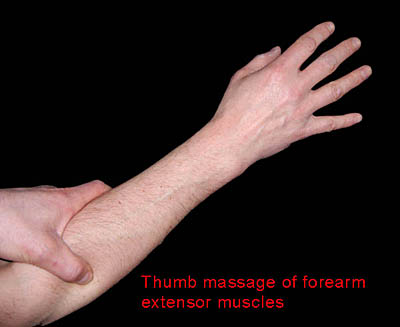
If you are in any doubt about what these muscles do, press your thumb on your arm as above and raise your wrist up as if you were about to type. Also raise and wiggle your fingers. With your thumb, you should be able to feel the various extensor muscles tightening as your wrist and fingers raise.
If you find the extensor muscles to be in pain with the above procedure then these muscles are fatigued. It also means that ergonomically, you are not using your keyboard properly and are probably typing using the claw, which causes this type of problem. This type of condition is one of the most common mechanisms for RSI pain, but can easily be addressed by changing the way you type.
If you are experiencing pain in these muscles, it is time to try to relieve them which can be done by massage, icing and rest. Consult your doctor or a trained physiotherapist to find out the best techniques which may include ultrasound. You should also read my post about Trigger Point Therapy on extensor forearm muscles which describes my findings from an excellent book for self help in RSI diagnosis and massage techniques. You may also want to try to find a knowledgeable Trigger Point massage therapist.
It is also time to re-assess your typing technique otherwise you may be placing yourself at risk of an RSI type condition. This may send the forearm extensor muscles into a more permanently fatigued state, from which recovery may be difficult, and in some extreme cases may be impossible.
In my own case, forearm muscle fatigue is the primary mechanism for my RSI pain. Unfortunately for me, I learned of the prevention techniques several years after my symptoms began, when these symptoms had already become more persistent. I do however still get some much needed temporary pain relief these days from massage of the forearm extensor muscles and tendons, just not very long lasting , but my injury is after all a long term one.
Related articles on forearm extensor muscles :
Forearm extensor muscle overuse wrist position and RSI
Does forearm extensor trigger point massage offerer a potential cure for RSI?
Rate this post! [ratings]
69 replies on “Forearm Extensor Muscle Overuse and RSI”
Hi Craig,
Do your hands hurt just using computers/keyboard/mice? or do they hurt doing other things? Have you been tested for arthritis? Just curious.
Alan
Hi Alan,
I have been tested for other conditions but nothing has come up unfortunately, they started just hurting when I used computers originally but everything I do now that creates pain in the hands, getting dressed, washing, eating etc. Its the not knowing what the problem is but RSI seems the most logical as it came on when I started using computers heavily.
Craig
Hi Alan,
I sometimes have a knot and pain in the Extensor Carpi radialis brevis. I have been diagonsed with Rotator Cuff Tendonitis and I am going for PT twice a week and Therapeutic Massage once a week. It is on my Right hand and being right handed it is very hard for me to rest it completely.
I feel it is getting better but sometimes this forearm muscle knots up and I have to apply pressure on this knot to release it.
What are your suggestions to completely recover from this problem. Is my Tendonitis causing this issue?
Thanks.
I work at a gas station and well the knotting started after I started having to lift heavy items and
The pain has moved from my upper arm to my hands more of the top of my hand thumb and under arm that has started to swell is tht a bad thing or what should I do???
Hi Alan
I do quite a lot of indoor climbing. Especially Boulder. I was on 4 time a week sessions. after a few finger injuries and due to illness i have muscle pain in my forearms and triceps. Could you please advice for recovery?
Thanks
Hi Alan,
My hands hurt when i am doing mist things now, in the palms and if i type on the tops of my hands it burns and becomes really irritated.
I have been tested for arthritus but i hsve been told i dont have it. My hands left have not been normal since last august, and i am still of work infortunately. I have muscle pain in my left side of neck and upper back also. have had nerve conduction tests which were negative but not an emg yet. Any clues , they do get better with around 12 weeks of rest only to flame back up again gradually over the week, this is even away form computers 🙁
Hi Craig,
the best advice I can give at present is to look deep into the trigger point therapy route in the Trigger Point Therapy Workbook, coupled with the Mind-Body Dr Sarno approach of letting go of your injury mentally (there is a feedback loop). I have said many times on this site that it is physical and mental problem (the ratio will vary from person to person), and both need addressed simultaneously otherwise you will get stuck in the endless RSI pain loop.
Alan
look into trigger point therapy.
look into trigger point therapy
Hi guys,
I posted on here months ago about my RSI injury. It’s been just under a year since the original injury happened – both forearms flared up with great pain and feelings of weakness after a 2 week musical (i’m a double bass player).
It took me 11 months to find the real source of the pain – I tried physio, chiropractor, painkillers, periods of rest – none of it really worked. I had periods of a few weeks which went well but as a rule, nothing worked. That was until I started to do yoga/pilates/stretching. I only started 4 weeks ago but have been very successful in unlocking my neck and shoulders which I have found to be incredibly tight from over a decade of playing music. It seems that this has been the root of my problem – that and bad posture. I have not had any of the same pain/weakness as before and it’s only getting better and better!
Therefore I would recommend all of you try and get into a strict yoga regime doing at least 30 minutes per day focussing on your neck and shoulders. I am lucky enough to have a Yoga instructor in my family but to those who don’t, just book 1 session with a yoga instructor to get a routine together and I guarantee it will be well worth the money! Yoga is an amazing healer.
good luck to all of you and I hope that you all find relief as soon as possible from such an all encompassing injury.
Sam
P.S. for any more information, feel free to email me at wheatistheonlyway@hotmail.com
Hi Sam,
Glad to hear yoga worked for you. I do yoga regularly. Its not a fix all for everyone though, but it is a very good compliment to other approaches for many people with RSI.
Alan
Thanks for the advice alan, i agree will try to see those options and work though them.
Sam, Any chance you can give me a few of the names you the yoga pilates stretches you do as i have investigated this but was not sure which exercises to do. I too have tight scalne muscles and upper back muscles so any of the ones you could give me would be a great help 🙂
I too have RSI, I have been investigated for nerve entrapment, have had nerve conduction which was all normal, MRI hands and neck all normal, bone scans etc all normal.. yet, I still have weakness and fatigue in both forearms. I did type for 20 hours a week, now I can’t lift paper without aching. I’ve been bad for 3 months and people think I’m lying when I tell them how bad it is, especially when nothing has ‘shown up’ yet. I have good hours and bad hours now, just hoping to be able to use my hands for a full day again one day soon! I think I will try some trigger point therapy. how long has this lasted for other people?
Hi Kim,
trigger point therapy of the forearm, elbow, shoulder and neck can all help with RSI. Its definitely worth looking at.
Alan
Hi Craig,
If you’d like to send me your email privately (to wheatistheonlyway@hotmail.com) I am in the middle of putting together a document of the stretches that I’ve been doing and will send it over to you.
All the best,
Sam
Hi Kim,
So sorry to hear about your current problems with RSI. Mine has been going for just under a year so far and I’ve only just started to make progress. That being said I was not clever about the way I went about the healing process for many months so with the right approach I am hopeful you will see results soon.
Sam
Hi Sam,
I tried your email address but unfortuntley got an undeliverable notice. Did have it correct: wheatistheonlyway@hotmail.com – mine is craigalanjones@hotmail.com if that helps.
All the best Craig
I am a rn, for 3 weeks now I’ve been experiencing throbbing/sharp pain on my left forearm that radiates to my hand/wrist, pain so intense at night when I’m asleep, to the point I wake crying not able to move left arm as though feeling dead, any treatment or suggestion?
just a note to thank you for this page
first had RSI symptoms 3 years ago but recovered; they have recurred now.
There’s a lot of information about RSI, and I’ve had conflicting accounts from doctors but the information on this page reflects my situation. Thanks for summing it up so succinctly. The images are really helpful.